Wound bed preparation (WBP) is standing the test of TIME. Pun intended. The success perhaps lies in the way in which the original WBP concept and subsequent framework have continued to evolve and adapt over 25 years. This post explores a case study of the most recent article in the WBP series published in Advances in Skin & Wound Care in 2024.
The Wound Bed Prep 2024 article, like those before it, broke new ground. It was the first with a nurse, Hiske Smart, MA, RN, PG Dip (UK), IIWCC(Can), as lead author. It introduced the 1-10 numbered components to the framework figure.
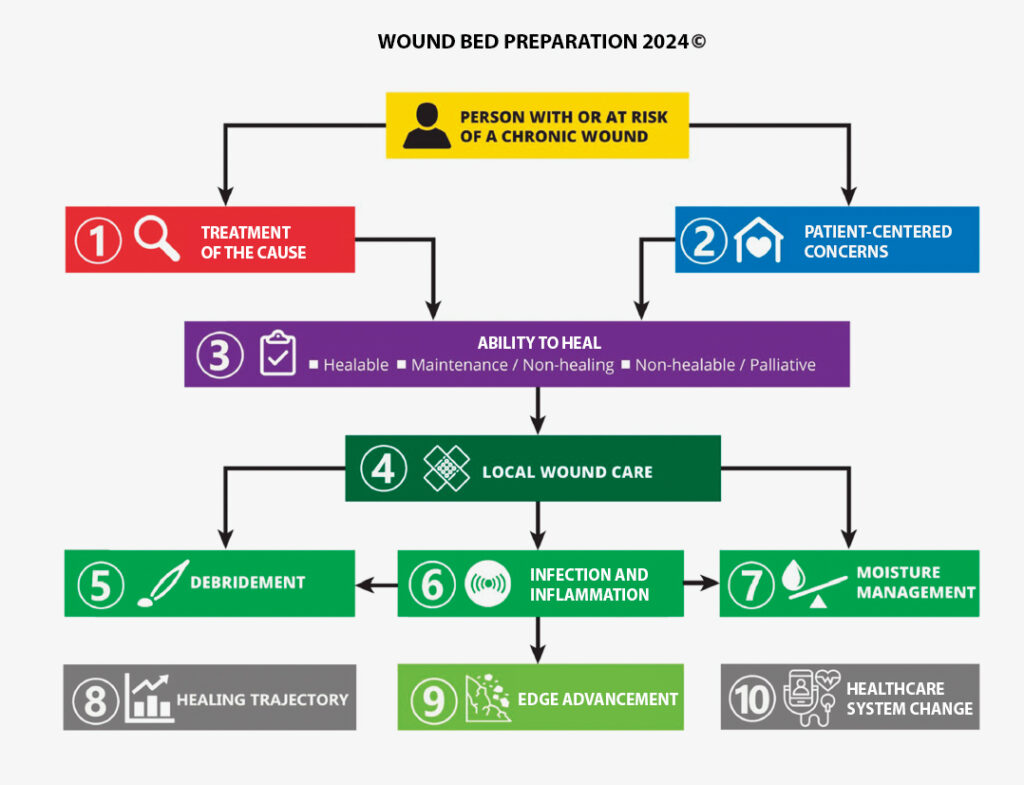
Copyright WoundPedia, 2024.
Lead author Hiske Smart described why this latest iteration was important and what she hoped it would achieve.
“This paper is the compilation of the thinking of 41 key international experts on what should be accepted as the minimum standard in rendering evidence informed diabetic foot care, regardless of the resources that are available, or not available. It also follows the WBP framework to the letter with recommendations that reached 88% consensus between the experts. Hence an important paper that is starting to shape global practice slowly but surely. Reaching those clinicians in resource poor environments that feel despondent in thinking they cannot do much, by opening up their perspective to the clinical tools that are readily available and in using those more effectively. This paper had one purpose and that was to open possibilities of how much can be done with very little” – Hiske Smart, MA, RN, PG Dip (UK), IIWCC(Can).
One of the original architects of wound bed preparation is R. Gary Sibbald, MD, DSc (Hons), MEd, BSc, FRCPC (Med)(Derm), FAAD, MAPWCA, JM. Dr. Sibbald was one of a handful of wound care clinicians who first described the term in 1999-2000. Wound Bed Preparation: A Systematic Approach to Wound Management became a seminal piece of work, published in Wound Repair and Regeneration in 2003. The international advisory board was chaired by the late Professor Gregory S. Schultz, PhD and included advisory board members Elizabeth A. Ayello, PhD, MS, BSN, RN, CWON, ETN, MAPWCA, FAAN, Caroline Dowsett, PhD, MSc, BSc (Hons), Dip N, D.N, RGN, BEM, Vincent Falanga, MD, FACP, Keith Harding, CBE, FRCGP, FRCP, FRCS, FLSW, Marco Romanelli, MD, PhD, R Gary Sibbald, MD, DSc (Hons), MEd, BSc, FRCPC (Med)(Derm), FAAD, MAPWCA, JM, Michael Stacey, DS, MBBS, FRACS, Luc Téot, MD, PhD, and Wolfgang Vanscheidt, MD. It was funded by Smith & Nephew. The project proved an inflection point in my career, and I am honoured to have been the project manager and one of the co-authors of the WBP 2024 article. In fact, Opencity is also synonymous with the project, as I explained elsewhere. What we had not foreseen was the collaborations between different members of the advisory panel, which have continued to this day. We were all especially saddened by the passing of Professor Schultz. In this video, Dr. Sibbald describes the latest WBP2024 framework.
Dr. R. Gary Sibbald describes some of the core components of the WBP2024 article published in Advances in Skin & Wound Care.
One of the criticisms of WBP has been the challenge of translating high science into practical bedside care. As with any new concept, time has enabled the development of practice enablers, cost-effectiveness analyses, case studies, and applications to different complex wounds (diabetic foot ulcers, pressure injuries, and leg ulcers) and acute wounds. Much of the clinical evidence assumes fully resourced centres supported by interprofessional teams. Many of the WBP2024 co-authors enabled us to reimagine WBP in limited-resource environments. This is not a sole domain of less westernized countries … there are many remote, rural, or Indigenous/Aboriginal communities across North America and Oceania. New interventions have come to market in the last two decades, or evidence for their use has increased. The development of the WBP2024 work also brought together more than 41 interprofessional experts in wounds, including 12 nurses. The lead authors drafted the 32 statements, which were subjected to a modified e-Delphi consensus process using a 4-point Likert scale with an 80% threshold, with 2 rounds of comments.
“John was the well-oiled engine room that only switched off once the project was completely done” – Hiske Smart.
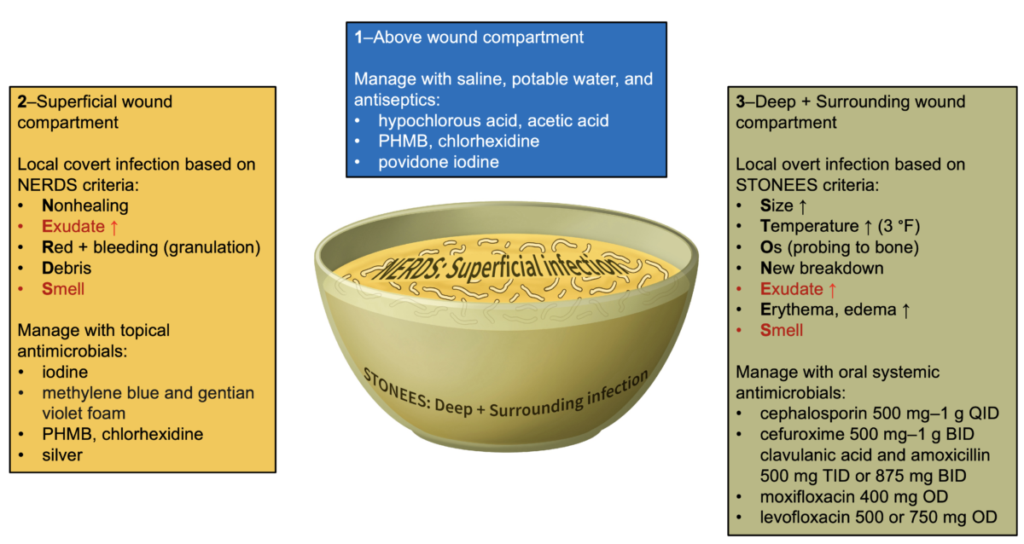
I am so fortunate to have the opportunity to collaborate with these 41 co-authors and am honoured to be a member of the WoundPedia team. Dr. Sibbald and I collaborated again, co-authoring a practice point for Advances in Skin & Wound Care titled Connecting Wound Bed Preparation 2024, Therapeutic Index, Covert, and Overt Infection. Earlier versions of the WBP papers (2006, 2011, 2015, 2021) included many quick-reference guides or enablers, such as tables and figures from PowerPoint slides. Opencity Inc. has been able to bring some graphic design capabilities to these figures to improve their clarity and comprehension. An example is the soup bowl in the practice point, shown below. Dr. Sibbald, Hiske, and I collaborated again with others on the Wound Care Essentials 6th edition chapter 1 on WBP due for publication late 2026.
Little-known factoid: while TIME is attributed to the Schultz et al., 2003 paper, it is never referred to as the acronym TIME. Table 1 describes the elements of what has become TIME [non-viable tissue, infection/inflammation, moisture imbalance, and edge effect].
References
Schultz, G. S., Sibbald, R. G., Falanga, V., Ayello, E. A., Dowsett, C., Harding, K., … & Vanscheidt, W. (2003). Wound bed preparation: a systematic approach to wound management. Wound Repair and Regeneration, 11, S1-S28.
Sibbald, R. G., & Gregory, J. H. (2025). Connecting Wound Bed Preparation 2024, Therapeutic Index, Covert, and Overt Infection. Advances in Skin & Wound Care, 38(1), 53-5. https://doi.org/10.1097/ASW.0000000000000267
Smart, H., Sibbald, R. G., Goodman, L., Ayello, E. A., Jaimangal, R., Gregory, J. H., … & Zacharias, R. (2024). Wound bed preparation 2024: Delphi consensus on foot ulcer management in resource-limited settings. Advances in Skin & Wound Care, 37(4), 180-196. https://doi.org/10.1097/ASW.0000000000000120
Wound Bed Preparation framework and soup bowl figure reproduced courtesy of WoundPedia. Featured image of the international advisory board in Paris in July 2002, sponsored by Smith & Nephew.