

The SARS-Cov2 pandemic was devastating for individuals, families, and communities. Nevertheless, the crisis did prompt an exponential advancement in virtual care. Many of the tools now commonplace were unfamiliar in 2019. The concept of remote monitoring and care is not new. Yet, during the pandemic, health care professionals looked to their associations for guidance on how to do it well. Nurses Specialized in Wound, Ostomy and Continence Canada was one of those to develop a specific Virtual Care Toolkit.
An expert panel of Nurse Specialized in Wound, Ostomy, and Continence (NSWOC) began a formal literature review in the fall of 2022, aiming to develop a toolkit for nurses to deliver virtual consultations across Canada. Therein lies a conundrum. Nurses and other health care professionals are licensed to practice by different provincial/territorial colleges to work in that jurisdiction. The essence of remote care is that it isn’t bound by borders.
This pioneering toolkit, designed by the dedicated task force pictured below, provides a comprehensive resource to empower NSWOCs in navigating the complexities of virtual care delivery. No longer are NSWOCs required to figure it out as they go, as many had done in 2020. Congratulations to project lead Laureen Sommerey, MSN, BScN, RN, NSWOC, WOCC(C) and the whole task force.
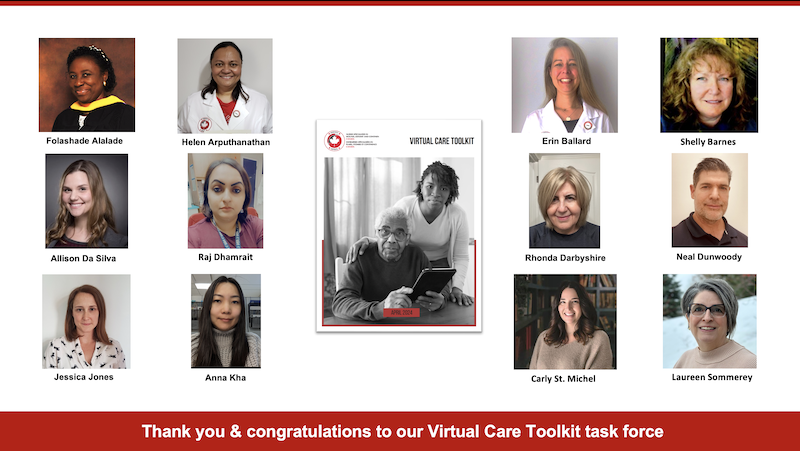
The definition of virtual care adopted was
The use of innovation and technology to connect providers to one another and providers to [clients] to deliver health services. [Reference Alberta Health Services, 2021, p 25]
Opencity was not involved in the project from the start. We became involved around six months into the group’s literature review. As the project evolved, virtual consultation became virtual care, reflecting the term’s broader use in the literature. Specific small groups worked to develop section content reflecting:
- Legal and regulatory considerations
- Technology
- Equity-oriented care
- Delivery of care
- Knowledge translation
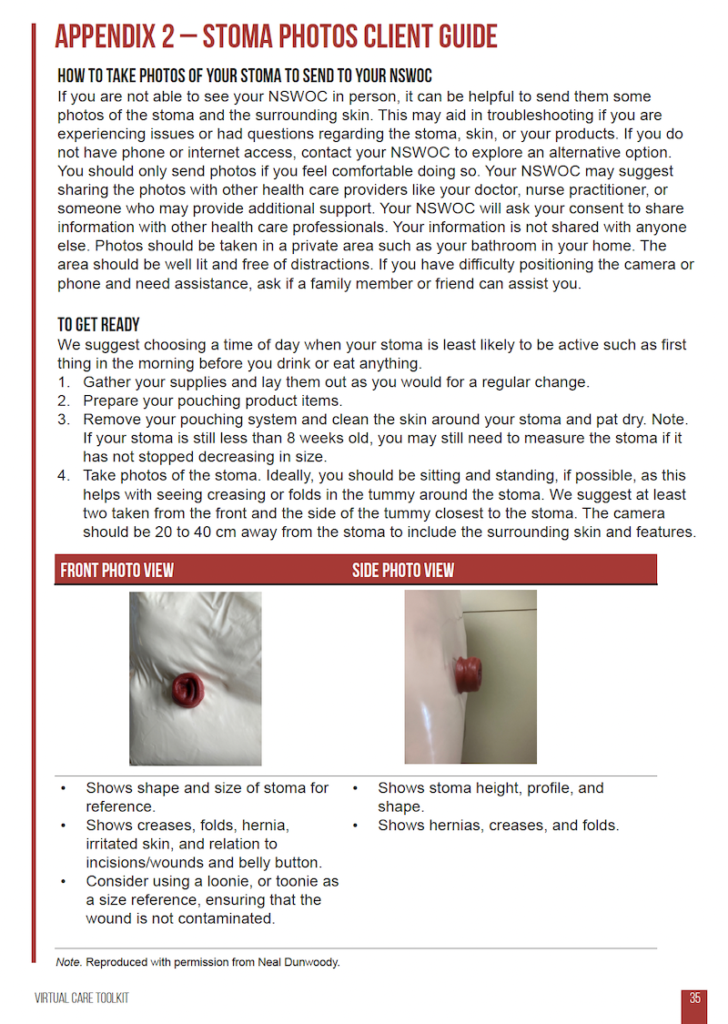
The regulatory nature of the topic necessitates seeking some expert opinion to critique the drafted sections and document before publication. This included input on some legal aspects, patient consent, and professional liability protection. Fourteen NSWOCs peer reviewed the toolkit prior to NSWOCC Board review and approval. During the course of content development, a guide for clients on photographing their stoma was developed.
Although the toolkit was focused on NSWOC practice, some Skin and Wellness Associate Nurses (SWANs) and other nurses have possessed the skills, knowledge, and judgment to provide virtual consults – subject to their provincial/territorial college scope of practice policy.
Leveraging QR codes
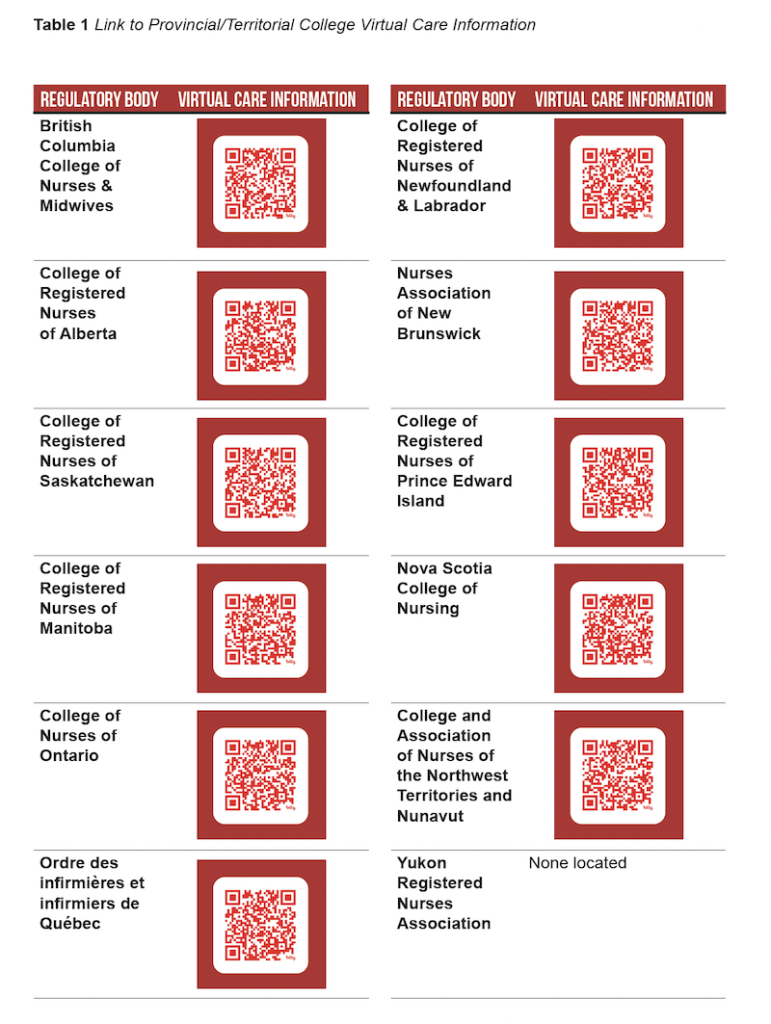
There was a time around 2012 when it even seemed QR codes might disappear. History now shows that they have exploded and become ubiquitous in how we navigate the digital world. The NSWOCC Virtual Care Toolkit was the first of our projects to consciously make it a central, integral component of the document design. The toolkit was about life in a virtual digital world, and so QR codes seemed to epitomize the use of technology. We have incorporated them in subsequent projects. Links (and QR codes) were correct at the time of publication, while recognizing that many health systems, associations, regulatory bodies / nursing colleges will update their documents.
The presentation of the finished document also attempted to reflect the nature and essence of a toolkit. The usual acknowledgements, lists of task force members, and methodology therefore appear at the end rather than in the conventional preamble pages.
Contributing to NSWOC Standards
Post-COVID, the field has continued to expand, with new publications on remote patient monitoring and the care of persons in resource-limited settings. As NSWOCC works on the fourth edition of the NSWOC Standards, much of the work on the Virtual Care Toolkit will be reflected and updated. Providing uninterrupted care for clients is surely an essential goal for Canada’s universal access to health services. One specific observation in the development of the toolkit was the preponderance of evidence discussing wounds and the absence of literature discussing ostomy and continence virtual care. The NSWOCC Standards 4th edition is scheduled for publication in spring 2027.
I worked closely with John Gregory (Opencity Inc.) in the development of the Virtual Care Toolkit | NSWOCC. The purpose of this toolkit was to provide NSWOC with practical information and tools to assist them to implement virtual care in their workplace. John was invaluable in keeping the project on time. His guidance and writing skill allowed us to develop a cohesive document that was written by a number of writers. His team was able to produce a professional document that our entire project team is proud of. – Laureen Sommerey, MSN, BScN, RN, NSWOC, WOCC(C) – project lead.
Thanks to the members of my team who contributed to the quality of the final toolkit. These include Lisa Moulton and Natasha Wilson. Exceptional work as always.
Images copyright of NSWOCC, 2024.